Happy Thanksgiving to readers of Princeton Nature Notes, now 17 years old--the blog, that is, and maybe even some of the readers. I will be leading a nature walk this Sunday, Nov. 26, from 1-3pm, open to all. Meet at the main parking lot for Herrontown Woods, off Snowden Lane. I had hoped to show off what I call the color-coded forest, but a storm of heavy wind and rain stripped most shrubs of their remaining leaves. It will still be good to have a hike, though, and you can see in this post what area woodlands looked like until just a few days ago.
November is when woodlands turn into one of those paintings where you match the color to the number. It's a time when you can gaze into the distance and identify every woody plant by its color. For instance, in this photo of a woodland overlooking the canal in Kingston, check out the yellow in the upper right. That's what's left of the Norway maple leaves, which turn color later than the native maples, and seem to know no other color than yellow in the fall. And the green in the understory? That is bush honeysuckle--what I call the "second forest." It's still green because it evolved on a different continent with a different climate, and so its timing is different from the native flora in spring and fall.
Seen this past week from the cliff in Herrontown Woods, the color coding was much more complex, with non-native Photinia, winged euonymus, and bush honeysuckle mixing with native species.
Here's a glorious dogwood along the red trail.
Up on the ridge, the maple-leaved Viburnums develop subtle shadings.
In our "cultural zone" between the Barden and Veblen House, young white oaks turned a rich burgundy earlier in the month. I tell people it's called a white oak because it turns red in the fall. Red oaks mostly turn orange. Naturalists have been doing Stop Making Sense tours long before David Byrne got around to it.
And then there's Photinia villosa, which is both beautiful and concerning, given how densely it has come to dominate in areas across town in Mountain Lakes and the Institute Woods. A few specimens turn bright orange, while
most turn bright yellow, even when growing side by side. You won't see a Norway maple going rogue with orange in the fall.
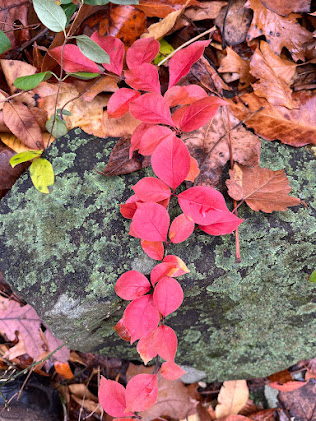
Another shrub, related to Photinia but just starting to show up in our woods,
is a mystery. I discovered it across town fifteen years ago in Rogers Refuge, and even crack botanists have yet to put a name on it.
Here you can see Photinia (yellow), American holly (evergreen), and in the foreground some sweetgum leaves (red). You can see how empowering the color coded forest is for distinguishing one species from another.
Barberry is beautiful as well. If only wildlife could feast on beauty, we'd be all set.
Bush honeysuckle--here photographed mid-month with a background of pink winged euonymus--keeps its leaves longer than other nonnatives. Even after all that wind and rain, it could still be easily spotted, clinging to its leaves.
A less common nonnative called jetbead (
Rhodotypos scandens) has found its way into one area of Herrontown Woods near the little red barn. Like bush honeysuckle, it keeps its leaves late into the fall. Having blended in all summer, it suddenly becomes exposed this time of year, thanks to the color-coding.
Small patches of this unusual native grass, found thus far only in a couple spots along the ridge, are easily spotted now as well.
You can see the long awn on the seed that gives this grass an attractive look, as if it has fancied itself up with long eyelashes. The coppery background leaf is beech, which will keep its leaves far into the winter, a reminder of November's color-coded artistry.