Showing posts with label whimsy. Show all posts

Monday, October 03, 2022

The Jazz Naturalist Travels to England

Botanical and musical interests merged recently, while touring England with a latin/jazz ensemble I've been musical director of for almost 40 years, called the Lunar Octet. It was a whirlwind tour, with seven gigs in five days. Along the way, I was able to catch glimpses of nature in the British Isles. 

One of our hosts, in Tunbridge Wells, has a delightful garden. The city is located in Kent, which is a county south of London. England as a country has no states, but rather lots of counties, like Hampshire, Yorkshire, and Devon, which seems to have lost its shire. Homes have addresses in England, but they are also sometimes given names. Our host lives in the Sandstone House. Are all english gardens like this? I'd be fine with it if so. Sheep graze peacefully in the front yard. Had never seen baby sheep grazing before. They're doing a great job.
Pink flamingoes are an indicator species for quirky habitat. Real flamingoes can be found in Africa and America. I once saw flocks of them at watering holes at the base of the Andes in the Patagonian desert in Argentina. Plastic pink flamingoes (Phoenicopterus plasticus) are a northern species, reportedly native to Massachusetts. 
The nylon strings draped over the front yard water feature looked at first like a sculpture, but may also be an elegant deterrent of whatever local water bird might be tempted to fly in and gobble up the fish.
There was a very scary guard dog, fortunately leashed.
And a guard bird kept an eye on us. People underestimate guard birds at their peril. 

There was a sheep patrolling the deck, looking like a character out of Wallace and Gromit. Very high security.

The garden deals with the death of trees in an interesting way. People tend to eliminate all signs of death from their gardens, but our hosts see demise as an opportunity. What's this?, you might ask.

I did ask, and was told that it's a thumb. That's a very positive thing to do with a dead tree trunk. 
And that split trunk in the distance, instead of cutting it down, 
they added a rope and called it a sling-shot.
If you've been steeped in the American ethic that trees should be allowed to grow naturally, the European treatment of trees can seem at first brutal. This eucalyptus, native to Australia, is lucky to have any limbs. Radical pruning is a means of controlling size, and is reminiscent of how grape vines are pruned back each year to not much more than a post sticking out of the ground. New growth sprouts from the tips. Pollarding is a fascinating technique with a long history, and some examples, intentional or not, can be found in Princeton.

Even more extreme pruning leaves just the trunk, as can be seen in this photo taken on the fly. It would be interesting to see how the trees respond to such extreme treatment.


There was a forest nearby that I didn't have time to explore, but the description sounds appealing.

"... a diverse mosaic of habitats: native broadleaf woodland of oak, birch, rowan, and hazel; areas of mature and younger conifer; fern-clad hollows; and patches of heathland where the heather, gorse, and purple moor-grass harbour a host of wildlife." 

"Fernclad hollows? Heather, gorse, purple moor-grass? If I had read the sign then and there, I would have launched myself up the trail for a closer look. Instead I took a photo of the sign, to ostensibly read later, and returned to the Sandstone House, still carrying the misconception that heather only grows further north, up towards Scotland. Rowan turns out to be the European equivalent of our mountain ash. Gorse looks a bit like a shrub called Scotch broom, with similarly bright yellow leguminous flowers. Both were introduced to the western U.S. and became invasive. It would have been good to see how gorse grows in its native habitat of Britain. The sign also says that Hargate Forest has its own invasive species, rhododendron, which is being removed. 

One big surprise was the presence of palm trees in southern Great Britain. The photo below was taken in Torquay (pronounced tor-KEY, home of Faulty Towers) where our band did a workshop at a boy's grammar school. A grammar school, I learned, doesn't refer to teaching grammar but to the need to test to get in. Palm trees, yuccas, Bird of Paradise--the flora along the south coast was more reminiscent of Pasadena, CA than my preconception of a uniformly cold, damp England.

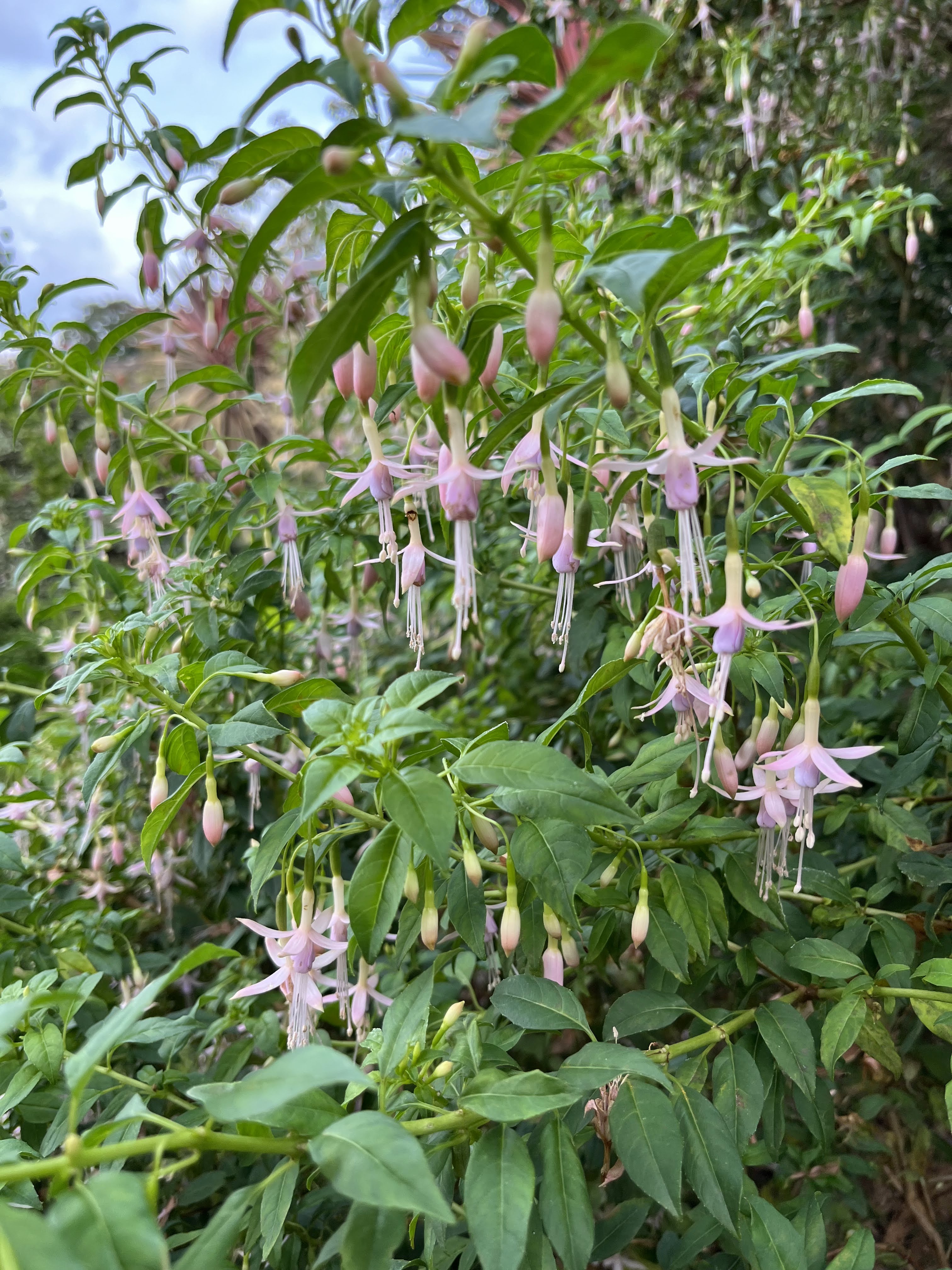
A little ways north, the climate still looked to be on the mild side, with fuchsia shrubs blooming in a garden designed for butterflies. It was at the Bristol Grammar School, reminiscent of Hogwarts, with uniformed students and a grand paneled dining hall. 
In a big blackbox theater, we performed our original music, then brought the students down to learn how to play a street samba rhythm. It is tremendously satisfying to perform for a sea of bright young faces, who listened well and gave back as much energy as we gave them. 

Most jazz musicians, leaving the gig, would not have noticed the teasel growing in the little butterfly garden that was trying mightily to do its part to counter 50 years of decline in butterflies and moths in Great Britain. Apparently native to England, teasel is a plant with a striking form that unfortunately has become highly invasive in the midwestern U.S., forming thick stands along highways. It probably will become problematic in NJ over time. Typically there's a lack of indigenous herbivores and diseases to keep an introduced plant in check when it becomes invasive on other continents. Teasel is, as mentioned, a striking plant, sometimes used in dry flower arrangements. Invasive is another way of saying "too much of a good thing." It would be interesting to see how teasel behaves in the English landscape, beyond the confines of a 10 X 20 butterfly garden.
Towards the end of the tour, our hosts in Nottingham, owners of a wonderful jazz club called Peggy's Skylight, put us up at their homes. The foliage in front of one of the houses along the street was decidedly American, with pampas grass and Virginia creeper.

The wannabe urban planner in me would like to take a moment to heap praise upon shallow setbacks, which I will pretend is a botanical term for locating homes close to the street. The small front yard thus created is a manageable space for having a small garden. Princeton has some neighborhoods with these smaller setbacks, but where homes are placed far from the street, not only is it less likely one will get to know one's neighbor, but the vast front yard thus created is also too big for most people to garden. The solution most homeowners gravitate towards is a boring, sterile expanse of mowed lawn. In England, I was glad for the feeling of embrace the narrow streets and their close-in buildings create.

There's a wonderful post about Virginia creeper by a woman in London who describes herself this way: "Bug Woman is a slightly scruffy middle-aged woman who enjoys nothing more than finding a large spider in the bathroom."

The blogger's description of self begs the question: Are Brits more comfortable than Americans with self-deprecation? In downtown Nottingham, we saw the Ugly Bread Bakery, 
which was just up the street from the Fatface department store. Do words get upcycled in England, to turn a negative into a positive? Though people were not above occasional complaint, we picked up on considerable positive energy, with the word "brilliant" being sprinkled liberally upon various things and actions, the way we might use "awesome."


One plant doing very well in England is English ivy, which looks to be a bonafide native. Vines typically bloom only when they climb something, which is why you never see English ivy, Virginia creeper, or poison ivy blooming when they are only spreading across the ground.

Along with the loss of wildlife, there's also the mourning of the attrition of hedgerows in the countryside. Apparently a lot were removed after WWII, when farming shifted towards maximum production and the hedgerows were standing in the way of expanding fields. Our pianist for the week, Adam Biggs, lives in Bath and described to me how hedgerows are not so much planted as "laid". There's a whole technique to creating and maintaining hedgerows, which are promoted as important habitat for wildlife.

We were fortunate in Nottingham to have an instantly likable host named Lex, a geographer with a liking for pirates and educational t-shirts.


A closer look reveals important anatomical differences between various strains of humanity.


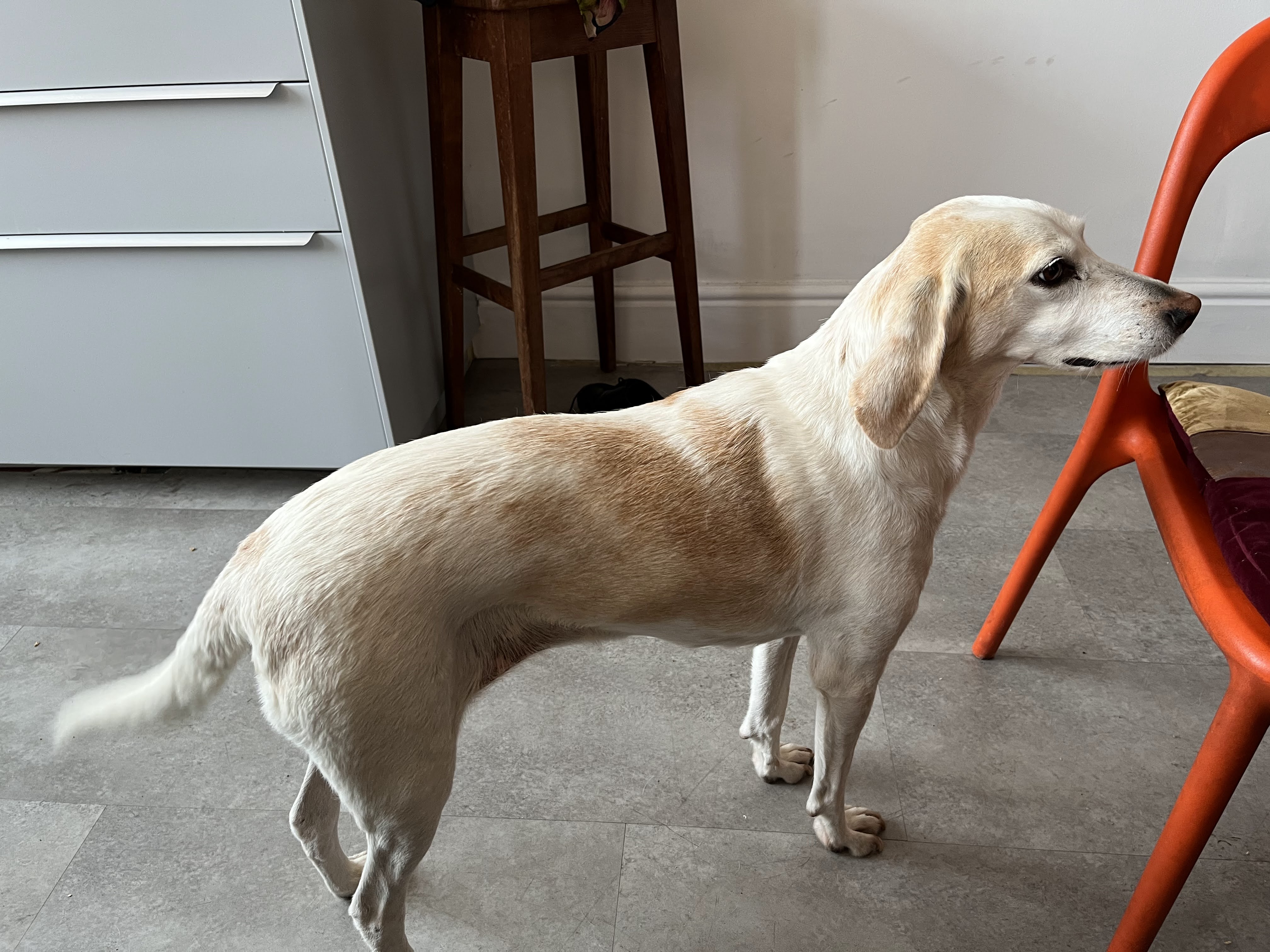
Their dog is a small version of a pure bred fox hound, the runt of the litter. The sort that hunts foxes, Lex explained, are much larger and specially bred. He described the tradition of fox hunting historically as more a form of warfare than sport--a means by which the upper class could demonstrate dominion over the lands populated by the tenant farmers. Fox hunting became logistically difficult as the landscape became more broken up into smallholder parcels whose owners were less willing to go along with the periodic invasion. 


While we found Robin Hood hanging out next to Nottingham Castle, built over ancient sandstone caves, he'd now have to drive an hour north to reach what remains of Sherwood Forest. There was no time for that, even though it looks like there's an amazingly old oak up there called the Major Oak.

We didn't see any fairs in Scarborough, but we did go, and did play for a thousand people at the jazz festival there. They called our music "joy jazz"--a new genre. Half the joy was in the music. The other half was in getting to see England and meet some of its people.

Wednesday, April 22, 2020

Becoming a Tree


A tree was spotted taking a selfie of its shadow with the Veblen House.

Yes, you can become a tree when the angle of the sun is right, and wave to the flowers growing below, and cast your mighty shadow across the expanse, to mingle with the land's many memories of the passing day.

Saturday, December 07, 2019

A Pumpkin's Smile That Would Not Die


Not everyone will see the smile that lingers here on a Michigan friend's front step long after Halloween has passed, just as not everyone will see the value in keeping any sort of organic matter around that is transitioning back to the air and soil from which it came.

This pumpkin, too, would have long been gone if not for its smile, and for an assignment given to its carver, an art student named Theadora, to draw an object in progressive stages of decomposition.

For me, this smile, here visible, is inherent in all things making nature's magical journey from death back to new life. For me, leaves keep their smiles all the way through winter and the following year, as they are slowly dismantled, losing themselves to a soil's riches, casting their carbon to the winds to take new forms.

In addition to the artist, the art teacher, and my friend Dan--the patient, appreciative father who took the photo--there is one other person to credit for this lingering smile.


As we know here in Princeton, many a pumpkin's well-carved expression has been lost, or reworked, by a neighborhood squirrel.

Squirrels tend to render one-eyed faces, or a face that is all mouth and no eyes,

though perhaps a couple squirrels teamed up to carve what here looks like a face with bunny ears.

Sometimes, if a squirrel is too hungry, it abandons all pretense of artistry and eats its own carving down to the ground.

Thea's smile in Michigan might too have been radically reworked by a local squirrel if not for the mother, Karen, who has been paying off the local squirrel mafia with peanuts in a shell, which she delivers one by one to their tender, appreciative paws on the back porch.

Moral: It takes an artist to make a smile, and a family to keep it going. I wonder what other stories this smile has to tell.


Friday, October 04, 2019

The Edible Aril of Yew


Said the Duke to the Count
in the town of the Prince,
"Have you heard of the Edible
Aril of Yew?"

Said the Count in reply,
"I don't see how a cone
could be anything tasty.
Since yews carry poison
we best not be hasty."

And so they walked on
past the closely trimmed hedge,
for fear of the toxins
in needle and seed,


the better for me on the arils to feed.

(Note how the seed sticks out a bit from the surrounding mug-shaped aril that's red and fleshy when ripe. The ripe aril is edible, but spit out the seed.)

Sunday, October 08, 2017

A Spider Seeks To Catch the Sun


One evening, when the sun was dipping low, an ambitious spider thought to itself, "What if my web could catch the sun, and I could live upon its energy for all my days?

It tried from top and tried from bottom, but the slippery sun slipped, slipped, down and away.


Another spider, across the windswept bridge, saw the moon and thought, "What if I could catch the moon in my web, and feast upon its dreams? What a beautiful life it would be."

It tried from top and tried from bottom, and thought for a moment to have captured a lifetime of wondrous moonlight. But the moon climbed higher, higher and away.

Even the moon's reflection stayed stuck upon the glassy water.


Then another spider, having to cast its net like an airborne fisherman, looking down as the lake looked back, said to all the others, "Let us leave the sun and moon to their risings and fallings, and catch instead the bugs, who catch their energy from the plants, who catch the sunlight from the sun, and we shall feast upon the sun's energy for all our days."

And so it came to be, that the spiders lived in their village stretched across the water, catching bugs and summer sunsets, and moonlit dreams, while cars sped by, seeing nothing.


Afterthought: I didn't think about it at the time, but photographing the sun, even when close to the horizon, may not be the best idea. Even if I was only looking at the sun's image in the iPhone, not the sun itself, that's some pretty intense light. Keeping my eyes flitting about, not resting the gaze, surely helped. Lots on the web about this, due to the recent eclipse. Apparently the sun isn't bad for the iPhone, especially at sunset, but I wonder about the intensity of the image on the screen, and articles especially warn against using selfie mode with the sun because of the reflection of radiation off the iPhone onto one's eyes. Fortunately, I kept the camera pointed at nature rather than self, and it seems like no damage was done.

Sunday, March 12, 2017

Banana Peel Slips on Self

A banana peel was found badly beaten last week on a main walkway leading into Princeton University. Passersby seemed completely indifferent to its fate. Sure, banana peels have a certain reputation for playing practical jokes, but has anyone considered that prank from the banana peel's point of view? Tossed thoughtlessly onto the hard pavement, left destitute, far from the comforting warmth of a compost pile, stripped of any hope of returning to the good earth, a banana peel gains no sympathy but instead must endure the heavy tread of Man. Those humans, with their heads held high, their thoughts in the stars, yet to land are made insensate by thick soles, knowing not the tyranny their feet impose with every step. People, once fallen, can pick themselves up again. Not so a banana peel.


Saturday, February 18, 2017

Did U Put the Ant in Cantaloupe?

It just doesn't seem right. Ants in February, feasting on tiny bits of cantaloupe on the kitchen counter when it's below freezing outside. And what sort of February is this, with cantaloupe for sale and a stretch of 60 degree days starting tomorrow? Has nature finally surrendered to the economy and abolished seasons altogether? Even the spelling of the word "cantaloupe" comes as a surprise, after a lifetime of not really noticing. Maybe one of our political parties will once again decide it dislikes all things french, and defiantly serve "cantalope" with American fries in the cafeteria of the U.S. Congress. Their presidential candidate will boldly declare that "This campaign is all about U", and promise that, to strengthen the nation's moral character, his first action as president will be to proclaim that the english language can't elope with French words. The other political party, tired of relentless negativity, will base its campaign on the slogan "Yes we canaloupe". By this time, a previous president will have indefinitely suspended all future elections, consigning the nation to a campaign season without substance and without end. Meanwhile, the meekest and tiniest among the ants, thriving in a climate made weird by too many tiny molecules in the atmosphere, and seeing the big-brained species devolving into nonsense, will seize the day and inherit the earth.


Sunday, January 22, 2017

Water: Our Backyard Artist in Residence

Even in the winter, or maybe especially in the winter, there's a lot of creativity and beauty in our backyard, thanks to a fillable-spillable 35 gallon black tub that catches runoff from the roof. If the night dips below freezing, the open water becomes a canvas for elaborate 3-dimensional designs.


Why the water doesn't freeze flat is hard to fathom. Sometimes, if the night's freeze has been light, these geometric shapes will frame miniature pools of open water that jiggle when the tub is tapped.

Cold brings out an unexpected beauty in water, and sometimes in ourselves, if we have clothes to match the weather, and take the cold as a bracing stimulant rather than, as Garrison Keillor would say, "nature's attempt to kill us."

These images were first posted at VeblenHouse.org as News Flash: Nature is a Geometer, in a post that links to an Exploratorium exhibit that shows how supercooled water can freeze over in a flash.

Friday, January 13, 2017

Morning Vision in the Trees

Yesterday, while my younger daughter was getting ready for school, I happened to look out the back window and saw a sight that became a vision:

After days of deep freeze, the temperature rises towards the 60s, and the squirrels are frolicking in the trees. By the tens they go. By the tens!? They flow like a spiraling current up trunks, out branches, leaping tree to tree, thinking three dimensionally. So cute and breathtaking, these acrobatic rats with charismatic tails! And so thoughtfully integrated, like the ads, with one black squirrel mixed in with the gray, all at ease and thrilled by the heady weather. Might humans, too, festering in ancient animosities, fall into long winter's slumber, then awaken in a January thaw to a fresh world redolent and warm, where life moves forward in leaps and bounds, and all fear of difference has been forgotten.

Saturday, December 31, 2016

Winter Has Been Downsized

Like the incredible shrinking chocolates that cost the same but come in smaller packages, winter isn't exactly filling its three month package like it used to. This Snow Wall-E was looking pretty lonely on Hawthorn, before it too succumbed to the browns and grays of mild weather.