Quite the surprise, arising the morning of January 1st,
to find a rose blooming in a Brooklyn backyard. My first thought on this first day was, "Why is this rose blooming? Doesn't it know it's winter?" And such a large, beautiful rose!Then I looked up and was surprised again, by two tall towers--iron exclamation points--rising along the back fence between two backyards in this row of brownstones. "What were those towers?," I asked my hosts.News from the preserves, parks and backyards of Princeton, NJ. The website aims to acquaint Princetonians with our shared natural heritage and the benefits of restoring native diversity and beauty to the many preserved lands in and around Princeton.
Sunday, January 07, 2024
A Rose Blooms in Brooklyn
Saturday, December 16, 2023
Handling Rainwater Runoff in My Yard--a Video
I was one of the hosts for a highly successful Green House Tour in Princeton this summer, organized by the Princeton Environmental Commission (PEC) and Sustainable Princeton. While other tours were of homes that demonstrate how to shift away from fossil fuel dependence, my tour was of my yard, and all the ways to utilize rainwater runoff to feed native plants in the landscape. The organizers made four excellent videos of the various tours, including one of my yard, below. Devan Sekaria did the filming, with editing mentorship by Seth Mellman.
(A good companion piece to the video is a post from ten years ago about how to incrementally shift your lawn to garden, called "The Incredible Shrinking Lawn, Thanks to Cardboard.")
Saturday, December 02, 2023
Default Landscapes That Lack the Touch of a Human Hand
Tended only by machines, this landscape of turf and tiny cannonball shrubs is what can be called a cultural default landscape, with closely mowed and trimmed plants kept in an eternal infantile state. The values expressed here are neatness and simplicity. Nature, being neither neat nor simple, becomes the tacit enemy of the suburban landscape. Subdivisions like this remind me of the motels we would plop down on the Monopoly board.
Here is another cultural default landscape, and by that I mean a landscape whose relative sterility is enforced by engrained cultural expectations. This is perhaps the largest detention basin I have ever seen, meant to capture runoff next to a public school. My guess is that the school cannot use the area for sports, and no one will think to turn it into a meadow, so it is destined to remain a barren mowed lawn in perpetuity.
Surprisingly, this large field across the street from the mansions has been left to grow up in broomsedge--a native grass. Not a high quality grassland by any stretch, but the less frequent (probably annual) mowing at least allows the grasses to reach sexual maturity.
Over near the hospital in Plainsboro, a vacant field demonstrates another kind of default landscape, where engrained cultural imperatives of farm or turfgrass have ceded control to invasive species. Cultural abandonment allowed three classic weeds to move in: mugwort, Chinese bushclover, and late flowering thoroughwort. Those first two are nonnative, with the mugwort being crowned "most likely to succeed" in abandoned fields.
Chinese bushclover appears to be newer on the scene in NJ. In the North Carolina piedmont, where I used to live, this highly aggressive species was planted by the Dept. of Transportation to reduce erosion along roadsides. Solving one problem, the DOT created another, as Chinese bushclover has since invaded native grasslands across the eastern U.S., and is now displacing other species along rights of way and on vacant lots in the Princeton area.
How does one counter the cultural and invasive species defaults in our area? One approach is to knock out the worst of the invasive species--the mugwort, Phragmitis, and Chinese bushclover--and then plant deer-resistant natives like late flowering thoroughwort and wild senna. These in turn will produce seeds that can start shifting the seed bank back from nonnative to native. It's all we've had time for thus far, in this field next to Herrontown Woods, preserved but otherwise forgotten. Maybe one day it can be a shining example of a native grassland, that, unlike so many others, has received the steady, ongoing, healing touch of a human hand.
Friday, November 24, 2023
Our Color-Coded Forest -- v2023
November is when woodlands turn into one of those paintings where you match the color to the number. It's a time when you can gaze into the distance and identify every woody plant by its color. For instance, in this photo of a woodland overlooking the canal in Kingston, check out the yellow in the upper right. That's what's left of the Norway maple leaves, which turn color later than the native maples, and seem to know no other color than yellow in the fall. And the green in the understory? That is bush honeysuckle--what I call the "second forest." It's still green because it evolved on a different continent with a different climate, and so its timing is different from the native flora in spring and fall.
Seen this past week from the cliff in Herrontown Woods, the color coding was much more complex, with non-native Photinia, winged euonymus, and bush honeysuckle mixing with native species.
Here's a glorious dogwood along the red trail.
Up on the ridge, the maple-leaved Viburnums develop subtle shadings.
In our "cultural zone" between the Barden and Veblen House, young white oaks turned a rich burgundy earlier in the month. I tell people it's called a white oak because it turns red in the fall. Red oaks mostly turn orange. Naturalists have been doing Stop Making Sense tours long before David Byrne got around to it.
And then there's Photinia villosa, which is both beautiful and concerning, given how densely it has come to dominate in areas across town in Mountain Lakes and the Institute Woods. A few specimens turn bright orange, while
most turn bright yellow, even when growing side by side. You won't see a Norway maple going rogue with orange in the fall.
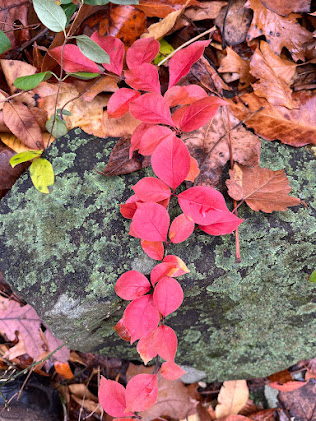
Here you can see Photinia (yellow), American holly (evergreen), and in the foreground some sweetgum leaves (red). You can see how empowering the color coded forest is for distinguishing one species from another.
Barberry is beautiful as well. If only wildlife could feast on beauty, we'd be all set.
You can see the long awn on the seed that gives this grass an attractive look, as if it has fancied itself up with long eyelashes. The coppery background leaf is beech, which will keep its leaves far into the winter, a reminder of November's color-coded artistry.
Monday, November 13, 2023
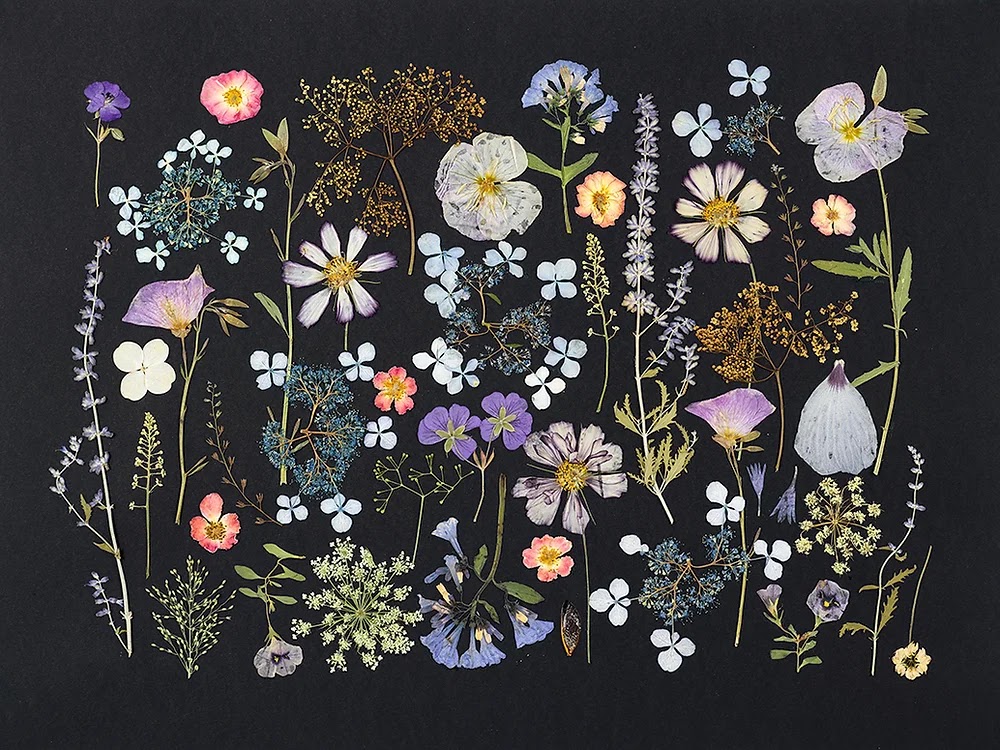
Liz Cutler's Pressed Flower Art
This is a post to honor the work and artistry of one of Princeton's great environmental educators, Liz Cutler. I first knew Liz as founding director of the nonprofit OASIS (Organizing Action on Sustainability In Schools), which promoted sustainability at 23 area schools. As sustainability director at Princeton Day School, she organized school garden tours and climate summits focused on mobilizing and empowering the next generation. Once a year, PDS would send a hundred kids to Mountain Lakes for community workdays back when I was the resource manager there. Later, we served together on the Princeton Environmental Film Festival committee.
Since leaving PDS, Liz says she's been consulting with schools all over the country to help them become more environmentally sustainable. One particularly nice-sounding gig: she spent this past winter as Master Teacher-in-Residence at The Island School in The Bahamas helping their young faculty improve their teaching practice.
Saturday, November 11, 2023
The Pleasure and Aesthetics of Native Seed Collection
Harvest of wild senna, seen in the first photo at a lovely stage when the leaves contrast with the dark seed pods, can be postponed considerably, as the pods hold onto the seeds for months.
The bright, fluffy clusters of ironweed seeds are easy to identify on stems that can reach 8 feet.Wednesday, November 01, 2023
The Fiery Look of Prairie Grasses in Fall
Friday, October 27, 2023
Update on Native Butternuts and Chestnuts in Princeton
There's a lot of gratitude being expressed towards trees these days. The gratitude tends to be towards trees in general, but this fall, I'm especially grateful for three trees in particular.
Sunday, October 15, 2023
Lorenz Hiltner--Plant Scientist and Potential Relative
"Hiltner became convinced that root exudates of different plants support the development of different bacterial communities. His definition of the rhizosphere in the year 1904 centered on the idea that plant nutrition is considerably influenced by the microbial composition of the rhizosphere."Lorenz Hiltner was part of the great European tradition of cutting edge research that was the envy of American scientists early in the 20th century. In researching the lives of my "adopted ancestors", American mathematician Oswald Veblen and atomic physicist Walter Colby--both of whom traveled frequently to Europe as the century began, wishing to emulate the great institutions of learning they found there--I see a contrast in trajectories. As the U.S. rose in prominence and innovation, European scientists became increasingly hampered by political conflict and instability, even before the Nazi rise and WWII.
"In the centennial symposium of Hiltner’s definition of the “Rhizosphere” in Munich in September 2004, more than 450 scientists gave tribute to his founding work on the rhizosphere and presented studies that continue on many of the ideas first brought to light by Hiltner."
Sunday, September 17, 2023
Last Chance to Pull Stiltgrass -- 2023
More on Stiltgrass, and a Success Story
Walking in the local woods, you've probably seen this kind of scene--what looks like a grassy meadow extending through the forest. In the filtered light of the understory, its simplicity and lushness may have some visual appeal. And yet, in some ways what you are looking at is the ecological equivalent of an urban food desert.
Stiltgrass is an introduced plant that could be called a pervasive invasive, able to thrive most anywhere and dominate whole landscapes. Its success has come in part through being inedible. As wildlife selectively eat native vegetation, the stiltgrass expands, preventing the native plants from rebounding.Though stiltgrass has covered large areas of woodland in the eastern U.S., we have found it worthwhile and even satisfying to counter its relentless incursions. Today in the Barden at Herrontown Woods, some volunteers pulled it out of a patch of native jewelweed along the edge of the parking lot.
Saturday, September 16, 2023
Where Have All the Spotted Lanternflies Gone?
Well, it's happened, at least in our neck of the woods.
It's true that people gave themselves over to squashing the pesky bugs--leafhoppers, actually--in spirited ways. (This photo shows one of the more creative approaches.) Some think the unusual weather has had an effect. Insect numbers overall have been down, be it the pollinators on backyard flowers, the odorous house ants that used to invade our kitchen, or spotted lanternflies. But my guess is that it has been the full-time predators, feathered or with eight legs or six, that are to be most congratulated for stemming the explosion of spotted lanternflies.
Just follow the trail of colorful wings that brightened a walk up towards Veblen House one day.